2020 Toyota Camry MPG
EPA ratings for the 2020 Toyota Camry run from 22–29 mpg in town to 31–41 on the highway, or 25–34 combined, depending on which of its 8 gasoline versions you look at.
The most efficient pairs the 2.5-liter 4-cylinder engine with an automatic transmission and front-wheel drive, at 34 mpg combined. The thirstiest version uses the 3.5-liter 6-cylinder engine with an automatic transmission and front-wheel drive and is rated 25 mpg combined. The EPA also rated a hybrid version, the best at 52 mpg combined. That matches the best gasoline version of the 2019 model.


| Version | Engine | Transmission | Drive | City | Hwy | Comb. | Fuel |
|---|---|---|---|---|---|---|---|
| Camry Hybrid LE | 2.5 L 4-cyl hybrid | Automatic (AV-S6) | Front-Wheel Drive | 51 | 53 | 52 | Regular · 170 g CO₂/mi |
| Camry Hybrid XLE/SE | 2.5 L 4-cyl hybrid | Automatic (AV-S6) | Front-Wheel Drive | 44 | 47 | 46 | Regular · 195 g CO₂/mi |
| Camry | 2.5 L 4-cyl | Automatic (S8) | Front-Wheel Drive | 29 | 41 | 34 | Regular · 264 g CO₂/mi |
| Camry LE/SE | 2.5 L 4-cyl | Automatic (S8) | Front-Wheel Drive | 28 | 39 | 32 | Regular · 279 g CO₂/mi |
| Camry XLE/XSE | 2.5 L 4-cyl | Automatic (S8) | Front-Wheel Drive | 27 | 38 | 31 | Regular · 284 g CO₂/mi |
| Camry AWD LE/SE | 2.5 L 4-cyl | Automatic (S8) | All-Wheel Drive | 25 | 34 | 29 | Regular · 309 g CO₂/mi |
| Camry AWD XLE/XSE | 2.5 L 4-cyl | Automatic (S8) | All-Wheel Drive | 25 | 34 | 28 | Regular · 315 g CO₂/mi |
| Camry | 3.5 L 6-cyl | Automatic (S8) | Front-Wheel Drive | 22 | 33 | 26 | Regular · 338 g CO₂/mi |
| Camry XSE | 3.5 L 6-cyl | Automatic (S8) | Front-Wheel Drive | 22 | 32 | 26 | Regular · 345 g CO₂/mi |
| Camry TRD | 3.5 L 6-cyl | Automatic (S8) | Front-Wheel Drive | 22 | 31 | 25 | Regular · 354 g CO₂/mi |
2020 Toyota Camry fuel cost per year
Driving 15,000 miles a year on regular gasoline at the September 2026 U.S. average of $4.36 a gallon, the 2020 Toyota Camry costs about $1,920 a year to fuel in its most efficient form (34 mpg combined), or roughly 13 cents a mile.
The thirstiest priced version (25 mpg combined) comes to about $2,610 a year, $690 more.
This is an estimate from EPA combined mpg and the EIA national average price; your cost depends on how and where you drive and on local prices.
2020 Toyota Camry specs
2020 Toyota Camry buyers could choose between 3 engines, according to EPA records: 2.5 L 4-cyl, 3.5 L 6-cyl and 2.5 L 4-cyl hybrid. It came with continuously variable (CVT) and automatic transmissions, in all-wheel drive or front-wheel drive versions. The EPA classes it as a midsize car.
| Engine size (L) | Cylinders | Transmissions | Drive | Versions |
|---|---|---|---|---|
| 2.5 L | 4 | Automatic (S8) | Front-Wheel Drive; All-Wheel Drive | 5 |
| 3.5 L | 6 | Automatic (S8) | Front-Wheel Drive | 3 |
| 2.5 L hybrid | 4 | Automatic (AV-S6) | Front-Wheel Drive | 2 |
2020 Toyota Camry problems
Owners have filed 284 complaints about the 2020 Toyota Camry with NHTSA, the U.S. vehicle-safety agency, as of October 2026.
Electrical system is the most-reported area (17% of component mentions), followed by engine (15%) and air bags (14%).
Spread over its time on sale, that is 40 complaints a year: fewer than the 2019 (51 a year) and more than the 2021 (27 a year).
That ranks 6th of 17 Toyota Camry model years (2008–2024), counting from the most complaints per year.
Of the 284, 14 mention a crash, 2 a fire and 12 an injury.
| Component | Mentions | Share |
|---|---|---|
| Electrical system | 68 | 17% |
| Engine | 60 | 15% |
| Air bags | 58 | 14% |
| Unknown or other | 46 | 11% |
| Fuel/propulsion system | 37 | 9% |
| Power train | 33 | 8% |
| Forward collision avoidance | 21 | 5% |
| Service brakes | 12 | 3% |
| Seat belts | 9 | 2% |
| Vehicle speed control | 9 | 2% |
| Lane departure | 7 | 2% |
| Structure | 7 | 2% |
| Visibility | 7 | 2% |
| Visibility/wiper | 7 | 2% |
| Steering | 5 | 1% |
| Back over prevention | 4 | <1% |
| Engine and engine cooling | 4 | <1% |
| Latches/locks/linkages | 3 | <1% |
| Tires | 3 | <1% |
| Electronic stability control (esc) | 2 | <1% |
| Gasoline fuel system | 2 | <1% |
| Suspension | 2 | <1% |
| Equipment | 1 | <1% |
| Other fuel system | 1 | <1% |
| Other/i am not sure | 1 | <1% |
| Seats | 1 | <1% |
What owners told NHTSA
The "airbag malfunction" light keeps coming on and off warning that there's something wrong with the airbags or the system itself. It's actually for something they have recalls for but my VIN number doesn't show up for the recall. …
I went a few months ago to Toyota to get an air flow valve replaced from a safety campaign for Toyota. My car engine light came on. Afterwards it never went off. My car shuts off after getting gas . …
The contact owns a 2020 Toyota Camry. The contact was notified of NHTSA Campaign Number: 23V865000 (Air Bags); however, the part to do the recall repair was not yet available. …
2020 Toyota Camry recalls
NHTSA lists 3 recall campaigns for the 2020 Toyota Camry.
The most recent, campaign 23V865000 from December 2023, concerns air bags.
20V064000 · February 6, 2020 · Engine and engine cooling
Problem: Porosity in the engine castings may result in cracks than can allow coolant to leak internally and/or externally.
Risk: A coolant leak can cause the engine to overheat and cause a vehicle stall in conventional gasoline vehicles, increasing the risk of a crash.
Remedy: Toyota will notify owners, and dealers will inspect and replace the engine including the engine block, as necessary, free of charge.
| Campaign | Reported | Component | Camry years covered |
|---|---|---|---|
| 23V865000 | December 20, 2023 | Air bags | 2020–2022 |
| 20V682000 | November 4, 2020 | Gasoline fuel system | 2018–2020 |
Safety ratings
NHTSA crash-tested 3 versions of the 2020 Toyota Camry; the best overall score is 5 out of 5 stars.
| Version tested | Overall | Frontal | Side | Rollover |
|---|---|---|---|---|
| 4-door FWD | ★★★★★ | ★★★★★ | ★★★★★ | ★★★★★ |
| HYBRID 4-door FWD | ★★★★★ | ★★★★★ | ★★★★★ | ★★★★★ |
| 4-door AWD | ★★★★★ | ★★★★★ | ★★★★★ | ★★★★★ |
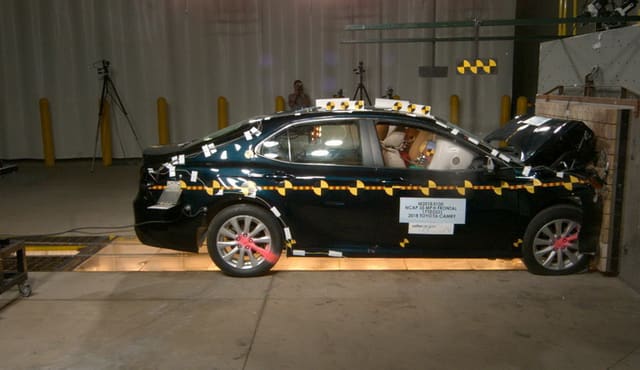
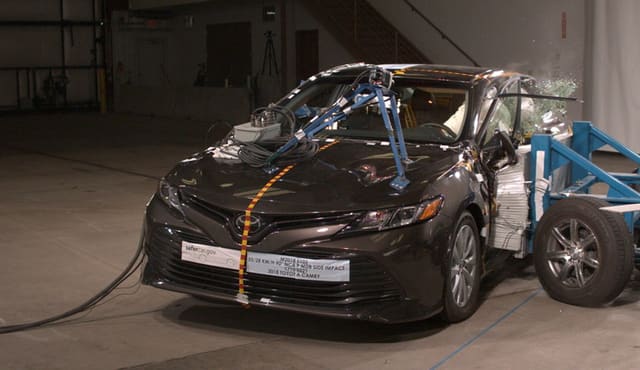
Crash-test photos: NHTSA (public domain). NHTSA can reuse a test for later model years of the same design.
Compared with other years
Complaints per year on sale divide each model year's NHTSA complaints by the years since it went on sale, so older and newer Toyota Camrys can be compared fairly. Among other 2020 models in the EPA's midsize cars class, the 2020 Nissan Sentra (33 mpg), 2020 Chevy Malibu (32 mpg) and 2020 Honda Civic (36 mpg) come closest on combined fuel economy.
| Year | Best mpg | Complaints | Per year on sale | Recalls |
|---|---|---|---|---|
| 2017 | 40 | 153 | 15 | 3 |
| 2018 | 52 | 779 | 86 | 8 |
| 2019 | 52 | 411 | 51 | 7 |
| 2020 | 52 | 284 | 40 | 3 |
| 2021 | 52 | 165 | 27 | 1 |
| 2022 | 52 | 65 | 13 | 1 |
| 2023 | 52 | 66 | 16 | 2 |
Every Toyota Camry model year compared →
Similar 2020 models
FAQ
Is the 2020 Camry a good car?
We don't rate cars, but the official data gives a picture. The 2020 Toyota Camry has 40 NHTSA complaints per year on sale (6th most of 17 model years), 3 recall campaigns, a best overall crash rating of 5 stars and up to 52 mpg combined from the EPA.
What are common 2020 Camry problems?
The components owners report most to NHTSA are electrical system (68), engine (60) and air bags (58). Complaints are unverified owner reports.
How many recalls does the 2020 Camry have?
NHTSA lists 3 recall campaigns. To see whether a recall is still open on a specific car, enter its VIN at nhtsa.gov/recalls.
What gas mileage does the 2020 Camry get?
The EPA rates the gasoline versions at 25–34 mpg combined (22–29 city, 31–41 highway). The hybrid versions reach up to 52 mpg combined.
How much does it cost to fuel a 2020 Camry per year?
About $1,920 a year for 15,000 miles in its most efficient form, up to about $2,610 for the thirstiest version, using EPA mpg and the September 2026 U.S. average regular gasoline price of $4.36 a gallon (EIA).