2023 Honda CR-V MPG
The 2023 Honda CR-V gets 27–28 mpg in the city and 32–34 on the highway (29–30 combined), across the 2 gasoline versions the EPA rated.
The most efficient pairs the 1.5-liter turbo 4-cylinder engine with a CVT and front-wheel drive, at 30 mpg combined. The thirstiest version uses the 1.5-liter turbo 4-cylinder engine with a CVT and all-wheel drive and is rated 29 mpg combined. The EPA also rated a hybrid version, the best at 40 mpg combined. That matches the best gasoline version of the 2022 model.


| Version | Engine | Transmission | Drive | City | Hwy | Comb. | Fuel |
|---|---|---|---|---|---|---|---|
| CR-V Hybrid FWD | 2.0 L 4-cyl hybrid | Automatic (variable gear ratios) | Front-Wheel Drive | 43 | 36 | 40 | Regular · 223 g CO₂/mi |
| CR-V Hybrid AWD | 2.0 L 4-cyl hybrid | Automatic (variable gear ratios) | All-Wheel Drive | 40 | 34 | 37 | Regular · 237 g CO₂/mi |
| CR-V FWD | 1.5 L 4-cyl turbo | Automatic (variable gear ratios) | Front-Wheel Drive | 28 | 34 | 30 | Regular · 290 g CO₂/mi |
| CR-V AWD | 1.5 L 4-cyl turbo | Automatic (variable gear ratios) | All-Wheel Drive | 27 | 32 | 29 | Regular · 305 g CO₂/mi |
2023 Honda CR-V fuel cost per year
Driving 15,000 miles a year on regular gasoline at the September 2026 U.S. average of $4.36 a gallon, the 2023 Honda CR-V costs about $2,180 a year to fuel in its most efficient form (30 mpg combined), or roughly 15 cents a mile.
The thirstiest priced version (29 mpg combined) comes to about $2,250 a year, $80 more.
This is an estimate from EPA combined mpg and the EIA national average price; your cost depends on how and where you drive and on local prices.
2023 Honda CR-V specs
2023 Honda CR-V buyers could choose between 2 engines, according to EPA records: 1.5 L 4-cyl turbo and 2.0 L 4-cyl hybrid. It came with a CVT, in all-wheel drive or front-wheel drive versions. The EPA classes it as a small sport utility vehicle.
| Engine size (L) | Cylinders | Transmissions | Drive | Versions |
|---|---|---|---|---|
| 1.5 L turbo | 4 | Automatic (variable gear ratios) | Front-Wheel Drive; All-Wheel Drive | 2 |
| 2.0 L hybrid | 4 | Automatic (variable gear ratios) | Front-Wheel Drive; All-Wheel Drive | 2 |
2023 Honda CR-V problems
Owners have filed 633 complaints about the 2023 Honda CR-V with NHTSA, the U.S. vehicle-safety agency, as of October 2026.
Steering is the most-reported area (48% of component mentions), followed by forward collision avoidance (8%) and lane departure (6%).
Spread over its time on sale, that is 156 complaints a year: more than the 2022 (69 a year) and about as many as the 2024 (157 a year).
That ranks 4th of 17 Honda CR-V model years (2008–2024), counting from the most complaints per year.
Of the 633, 22 mention a crash, 2 a fire and 17 an injury.
| Component | Mentions | Share |
|---|---|---|
| Steering | 397 | 48% |
| Forward collision avoidance | 65 | 8% |
| Lane departure | 53 | 6% |
| Unknown or other | 42 | 5% |
| Electrical system | 38 | 5% |
| Service brakes | 34 | 4% |
| Engine | 28 | 3% |
| Visibility/wiper | 27 | 3% |
| Fuel/propulsion system | 23 | 3% |
| Structure | 23 | 3% |
| Power train | 19 | 2% |
| Gasoline fuel system | 17 | 2% |
| Vehicle speed control | 14 | 2% |
| Air bags | 8 | <1% |
| Back over prevention | 7 | <1% |
| Exterior lighting | 6 | <1% |
| Wheels | 6 | <1% |
| Visibility | 5 | <1% |
| Seats | 3 | <1% |
| Engine and engine cooling | 2 | <1% |
| Tires | 2 | <1% |
| Parking brake | 1 | <1% |
| Seat belts | 1 | <1% |
| Suspension | 1 | <1% |
| Traction control system | 1 | <1% |
What owners told NHTSA
I am submitting a formal safety complaint regarding our 2023 Honda CR-V because of repeated and increasingly serious problems involving the vehicle's computer/electronic systems, automatic steering/driver-assistance systems, and automatic braking system. …
The CMBS stopped working after the update was installed & the dealer said that ius the way it works & won't correct the problem.
The lane keeping assist system problem contact your dealer keeps appearing on my dashboard when I start the car and pull away.
2023 Honda CR-V recalls
NHTSA lists 8 recall campaigns for the 2023 Honda CR-V.
The most recent, campaign 26V663000 from October 2026, concerns tires.
Gasoline fuel system accounts for 2 of the 8 campaigns, more than any other area.
24V745000 · October 3, 2024 · Electrical system
Problem: The high voltage battery modules may have been manufactured incorrectly, which can cause the battery terminal or busbar to break and spark.
Risk: An electrical spark increases the risk of an injury or fire.
Remedy: Dealers will replace the battery module, free of charge.
23V588000 · August 17, 2023 · Power train
Problem: The electronic transmission may have been improperly manufactured, which can result in a loss of drive power.
Risk: A loss of drive power can increase the risk of a crash.
Remedy: Dealers will replace the electronic continuously variable transmission (e-CVT), free of charge.
23V092000 · February 16, 2023 · Seats
Problem: The front passenger seat back frame may not have been welded properly, which can cause the seat back position to fail in the event of a crash. As such, these vehicles fail to comply with the requirements of Federal Motor Vehicle Safety Standard numbers 207, "Seating Systems" and 201, "Occupant Protection in Interior Impact."
Risk: A seat back position that fails may not adequately restrain the occupant during a crash, increasing the risk of injury.
Remedy: Dealers will replace the front passenger seat back frame assembly, free of charge.
| Campaign | Reported | Component | CR-V years covered |
|---|---|---|---|
| 26V663000 | October 8, 2026 | Tires | 2023–2024 |
| 26V366000 | June 4, 2026 | Tires | 2023–2024 |
| 24V763000 | October 14, 2024 | Gasoline fuel system | 2023–2024 |
| 24V744000 | October 3, 2024 | Steering | 2023–2024 |
| 23V858000 | December 18, 2023 | Gasoline fuel system | 2013–2023 |
Safety ratings
NHTSA crash-tested 4 versions of the 2023 Honda CR-V; the best overall score is 5 out of 5 stars.
| Version tested | Overall | Frontal | Side | Rollover |
|---|---|---|---|---|
| SUV FWD | Not rated | ★★★★☆ | ★★★★★ | Not rated |
| SUV AWD | ★★★★★ | ★★★★☆ | ★★★★★ | ★★★★☆ |
| HYBRID SUV FWD | Not rated | ★★★★☆ | ★★★★★ | Not rated |
| HYBRID SUV AWD | ★★★★★ | ★★★★☆ | ★★★★★ | ★★★★☆ |
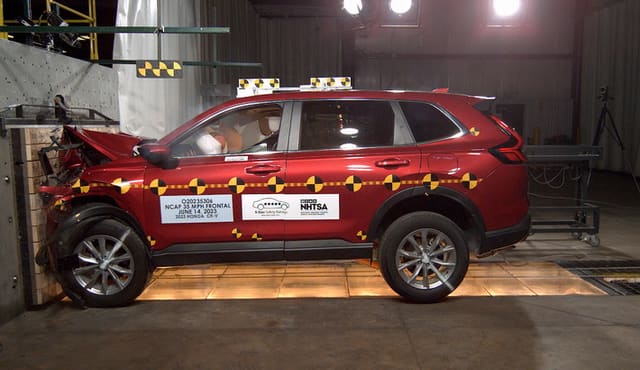
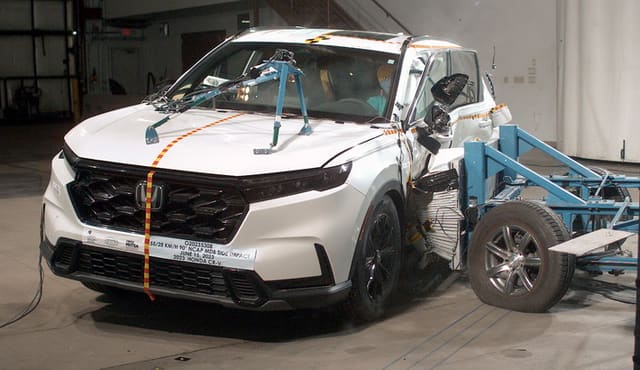
Crash-test photos: NHTSA (public domain). NHTSA can reuse a test for later model years of the same design.
Compared with other years
Complaints per year on sale divide each model year's NHTSA complaints by the years since it went on sale, so older and newer Honda CR-Vs can be compared fairly. Among other 2023 models in the EPA's small sport utility vehicle class, the 2023 Ford Escape (30 mpg), 2023 Toyota RAV4 (30 mpg) and 2023 Subaru Forester (29 mpg) come closest on combined fuel economy.
| Year | Best mpg | Complaints | Per year on sale | Recalls |
|---|---|---|---|---|
| 2020 | 38 | 441 | 62 | 9 |
| 2021 | 38 | 444 | 73 | 5 |
| 2022 | 38 | 348 | 69 | 6 |
| 2023 | 40 | 633 | 156 | 8 |
| 2024 | 40 | 481 | 157 | 5 |
Every Honda CR-V model year compared →
Similar 2023 models
FAQ
Is the 2023 CR-V a good car?
We don't rate cars, but the official data gives a picture. The 2023 Honda CR-V has 156 NHTSA complaints per year on sale (4th most of 17 model years), 8 recall campaigns, a best overall crash rating of 5 stars and up to 40 mpg combined from the EPA.
What are common 2023 CR-V problems?
The components owners report most to NHTSA are steering (397), forward collision avoidance (65) and lane departure (53). Complaints are unverified owner reports.
How many recalls does the 2023 CR-V have?
NHTSA lists 8 recall campaigns. To see whether a recall is still open on a specific car, enter its VIN at nhtsa.gov/recalls.
What gas mileage does the 2023 CR-V get?
The EPA rates the gasoline versions at 29–30 mpg combined (27–28 city, 32–34 highway). The hybrid versions reach up to 40 mpg combined.
How much does it cost to fuel a 2023 CR-V per year?
About $2,180 a year for 15,000 miles in its most efficient form, up to about $2,250 for the thirstiest version, using EPA mpg and the September 2026 U.S. average regular gasoline price of $4.36 a gallon (EIA).