2021 Ford F-150 MPG
The 2021 Ford F-150 gets 14–20 mpg in the city and 16–27 on the highway (15–23 combined), across the 20 gasoline versions the EPA rated.
The most efficient pairs the 3.0-liter turbo 6-cylinder engine with an automatic transmission and four-wheel drive, at 23 mpg combined. The thirstiest version uses the 3.5-liter turbo 6-cylinder engine with an automatic transmission and four-wheel drive and is rated 15 mpg combined. The EPA also rated a hybrid version, the best at 25 mpg combined. That is 1 mpg lower than the best gasoline 2020 version (24 mpg).


| Version | Engine | Transmission | Drive | City | Hwy | Comb. | Fuel |
|---|---|---|---|---|---|---|---|
| F150 Pickup 2WD HEV | 3.5 L 6-cyl turbo hybrid | Automatic (S10) | Rear-Wheel Drive | 25 | 26 | 25 | Regular · 349 g CO₂/mi |
| F150 Pickup 4WD HEV | 3.5 L 6-cyl turbo hybrid | Automatic (S10) | Part-time 4-Wheel Drive | 24 | 24 | 24 | Regular · 368 g CO₂/mi |
| F150 Pickup 4WD | 3.0 L 6-cyl turbo | Automatic (S10) | Part-time 4-Wheel Drive | 20 | 27 | 23 | Diesel · 446 g CO₂/mi |
| F150 Pickup 2WD | 2.7 L 6-cyl turbo | Automatic (S10) | Rear-Wheel Drive | 20 | 26 | 22 | Regular · 406 g CO₂/mi |
| F150 Pickup 2WD FFV | 3.3 L 6-cyl | Automatic (S10) | Rear-Wheel Drive | 20 | 24 | 21 | Gasoline or E85 · 424 g CO₂/mi |
| F150 Pickup 4WD | 2.7 L 6-cyl turbo | Automatic (S10) | Part-time 4-Wheel Drive | 19 | 24 | 21 | Regular · 432 g CO₂/mi |
| F150 Pickup 2WD | 3.5 L 6-cyl turbo | Automatic (S10) | Rear-Wheel Drive | 18 | 24 | 20 | Regular · 437 g CO₂/mi |
| F150 Pickup 2WD FFV | 5.0 L 8-cyl | Automatic (S10) | Rear-Wheel Drive | 17 | 24 | 20 | Gasoline or E85 · 446 g CO₂/mi |
| F150 Pickup 4WD | 3.5 L 6-cyl turbo | Automatic (S10) | Part-time 4-Wheel Drive | 18 | 23 | 20 | Regular · 445 g CO₂/mi |
| F150 Pickup 4WD FFV | 3.3 L 6-cyl | Automatic (S10) | Part-time 4-Wheel Drive | 19 | 22 | 20 | Gasoline or E85 · 445 g CO₂/mi |
| F150 Pickup 2WD | 3.5 L 6-cyl turbo | Automatic (S10) | Rear-Wheel Drive | 17 | 24 | 20 | Regular · 444 g CO₂/mi |
| F150 Pickup 4WD | 2.7 L 6-cyl turbo | Automatic (S10) | Part-time 4-Wheel Drive | 18 | 24 | 20 | Regular · 445 g CO₂/mi |
| F150 Pickup 4WD FFV | 5.0 L 8-cyl | Automatic (S10) | Part-time 4-Wheel Drive | 16 | 22 | 19 | Gasoline or E85 · 479 g CO₂/mi |
| F150 Pickup 2WD FFV | 5.0 L 8-cyl | Automatic (S10) | Rear-Wheel Drive | 17 | 24 | 19 | Gasoline or E85 · 463 g CO₂/mi |
| F150 Pickup 4WD | 3.5 L 6-cyl turbo | Automatic (S10) | Part-time 4-Wheel Drive | 17 | 23 | 19 | Regular · 468 g CO₂/mi |
| F150 Pickup Tremor 4WD | 3.5 L 6-cyl turbo | Automatic (S10) | Part-time 4-Wheel Drive | 16 | 20 | 18 | Regular · 498 g CO₂/mi |
| F150 Pickup 4WD FFV | 5.0 L 8-cyl | Automatic (S10) | Part-time 4-Wheel Drive | 16 | 22 | 18 | Gasoline or E85 · 495 g CO₂/mi |
| F150 Pickup Tremor 4WD | 3.5 L 6-cyl turbo | Automatic (S10) | Part-time 4-Wheel Drive | 16 | 20 | 18 | Regular · 503 g CO₂/mi |
| F150 RAPTOR 4WD | 3.5 L 6-cyl turbo | Automatic (S10) | Part-time 4-Wheel Drive | 15 | 18 | 16 | Regular · 553 g CO₂/mi |
| F150 RAPTOR 37 4WD | 3.5 L 6-cyl turbo | Automatic (S10) | Part-time 4-Wheel Drive | 15 | 16 | 15 | Regular · 578 g CO₂/mi |
| F150 RAPTOR 37 4WD | 3.5 L 6-cyl turbo | Automatic (S10) | Part-time 4-Wheel Drive | 14 | 16 | 15 | Regular · 596 g CO₂/mi |
| F150 RAPTOR 4WD | 3.5 L 6-cyl turbo | Automatic (S10) | Part-time 4-Wheel Drive | 14 | 18 | 15 | Regular · 593 g CO₂/mi |
2021 Ford F-150 fuel cost per year
Driving 15,000 miles a year on regular gasoline at the September 2026 U.S. average of $4.36 a gallon, the 2021 Ford F-150 costs about $2,970 a year to fuel in its most efficient form (22 mpg combined), or roughly 20 cents a mile.
The thirstiest priced version (15 mpg combined) comes to about $4,360 a year, $1,390 more.
This is an estimate from EPA combined mpg and the EIA national average price; your cost depends on how and where you drive and on local prices.
2021 Ford F-150 specs
2021 Ford F-150 buyers could choose between 6 engines, according to EPA records: 3.5 L 6-cyl turbo, 5.0 L 8-cyl, 2.7 L 6-cyl turbo, 3.3 L 6-cyl, 3.5 L 6-cyl turbo hybrid and 3.0 L 6-cyl turbo. It came with an automatic transmission, in four-wheel drive or rear-wheel drive versions. The EPA classes it as a standard pickup truck.
| Engine size (L) | Cylinders | Transmissions | Drive | Versions |
|---|---|---|---|---|
| 3.5 L turbo | 6 | Automatic (S10) | Rear-Wheel Drive; Part-time 4-Wheel Drive | 10 |
| 5.0 L | 8 | Automatic (S10) | Rear-Wheel Drive; Part-time 4-Wheel Drive | 4 |
| 2.7 L turbo | 6 | Automatic (S10) | Rear-Wheel Drive; Part-time 4-Wheel Drive | 3 |
| 3.3 L | 6 | Automatic (S10) | Rear-Wheel Drive; Part-time 4-Wheel Drive | 2 |
| 3.5 L turbo hybrid | 6 | Automatic (S10) | Rear-Wheel Drive; Part-time 4-Wheel Drive | 2 |
| 3.0 L turbo | 6 | Automatic (S10) | Part-time 4-Wheel Drive | 1 |
2021 Ford F-150 problems
Owners have filed 1,299 complaints about the 2021 Ford F-150 with NHTSA, the U.S. vehicle-safety agency, as of October 2026.
Power train is the most-reported area (26% of component mentions), followed by electrical system (10%) and exterior lighting (7%).
Spread over its time on sale, that is 214 complaints a year: more than the 2020 (105 a year) and the 2022 (161 a year).
That ranks 2nd of 17 Ford F-150 model years (2008–2024), counting from the most complaints per year.
Of the 1,299, 18 mention a crash, 7 a fire and 11 an injury.
| Component | Mentions | Share |
|---|---|---|
| Power train | 447 | 26% |
| Electrical system | 178 | 10% |
| Unknown or other | 124 | 7% |
| Exterior lighting | 120 | 7% |
| Engine | 111 | 6% |
| Visibility | 83 | 5% |
| Fuel/propulsion system | 67 | 4% |
| Service brakes | 66 | 4% |
| Visibility/wiper | 66 | 4% |
| Forward collision avoidance | 63 | 4% |
| Wheels | 54 | 3% |
| Steering | 49 | 3% |
| Structure | 48 | 3% |
| Back over prevention | 45 | 3% |
| Gasoline fuel system | 44 | 3% |
| Vehicle speed control | 28 | 2% |
| Engine and engine cooling | 21 | 1% |
| Lane departure | 21 | 1% |
| Suspension | 20 | 1% |
| Equipment | 17 | <1% |
| Parking brake | 12 | <1% |
| Hydraulic service brakes | 11 | <1% |
| Latches/locks/linkages | 10 | <1% |
| Seat belts | 7 | <1% |
| Air bags | 6 | <1% |
| Air service brakes | 2 | <1% |
| Tires | 2 | <1% |
| Buckle chest clip | 1 | <1% |
| Interior lighting | 1 | <1% |
| Seats | 1 | <1% |
What owners told NHTSA
The contact owns a 2021 Ford F-150. The contact stated that the vehicle was scheduled for repair under NHTSA Campaign Number: 26V402000 (Power Train); however, the part to complete the recall repair was not yet available. …
While driving truck, it had an electrical fritz that caused the car to become undrivable, with systems not responding. when stopped to power cycle, the car would accessory on but not attempt to start. the horn would go off randomly. …
The passenger Daytime Running Lamp (DRL) has stopped working on my 2021 Ford F-150. …
2021 Ford F-150 recalls
NHTSA lists 29 recall campaigns for the 2021 Ford F-150.
The most recent, campaign 26V489000 from July 2026, concerns back over prevention.
Power train accounts for 7 of the 29 campaigns, more than any other area.
26V402000 · June 24, 2026 · Power train
Problem: The transmission park pawl may engage while the vehicle is in motion, resulting in park system damage.
Risk: Park system damage may result in a vehicle rollaway, increasing the risk of a crash.
Remedy: Dealers will update the powertrain control module software, and inspect and replace any damaged transmission components as necessary, free of charge.
25V348000 · May 23, 2025 · Exterior lighting
Problem: An over-the-air software update to the body control module (BCM) may have disabled both reverse lights.
Risk: Inoperative reverse lights may fail to alert others that the vehicle is reversing, increasing the risk of a crash.
Remedy: Dealers will update the body control module software, free of charge.
25V169000 · March 14, 2025 · Power train
Problem: The Diagnostic Trouble Code (DTC) for low transmission fluid pressure may falsely activate and cause the transmission to unexpectedly shift into neutral.
Risk: An unexpected shift into neutral will cause a loss of drive power and increase the risk of a crash.
Remedy: Dealers will update the Powertrain Control Module (PCM) software, free of charge.
24V443000 · June 14, 2024 · Electrical system, Exterior lighting
Problem: An over-the-air software update to the body control module (BCM) may have disabled both reverse lights.
Risk: Disabled reverse lights cannot alert others that the vehicle is reversing, increasing the risk of a crash.
Remedy: Dealers will update the body control module software, free of charge.
23V163000 · March 10, 2023 · Visibility
Problem: The windshield wiper arms may break, causing the windshield wipers to fail.
Risk: Inoperative windshield wipers can reduce visibility in certain conditions, increasing the risk of a crash.
Remedy: Dealers will inspect and replace the wiper arms, as necessary, free of charge.
22V414000 · June 10, 2022 · Gasoline fuel system
Problem: A single vehicle may have been assembled without a fuel tank front attachment resulting in an unsecured fuel tank attachment strap.
Risk: An improperly attached fuel tank increases the risk of a fuel leak and potential for fire.
Remedy: Dealers will inspect and repair (if necessary) the fuel tank strap bracket, free of charge.
22V188000 · March 25, 2022 · Power train
Problem: The Diagnostic Trouble Code (DTC) for low transmission fluid pressure may falsely activate and cause the transmission to unexpectedly shift into neutral.
Risk: An unexpected shift into neutral will cause a loss of drive power and increase the risk of a crash.
Remedy: Dealers will update the Powertrain Control Module (PCM) software, free of charge.
22V142000 · March 11, 2022 · Visibility
Problem: The front windshield wiper motor may become inoperative, causing the wipers to fail.
Risk: Inoperative windshield wipers can reduce visibility in certain conditions, increasing the risk of a crash.
Remedy: Dealers will replace the front windshield wiper motor, free of charge.
21V805000 · October 15, 2021 · Air bags
Problem: The front-door side impact pressure sensor modules may have been damaged during supplier assembly, which can cause the side impact air bags to not deploy properly in a crash. As such, these vehicles fail to comply with the requirements of Federal Motor Vehicle Safety Standard number 214, "Side Impact Protection."
Risk: An air bag that does not deploy properly during a crash increases the risk of injury.
Remedy: Dealers will replace the driver and passenger front door side impact sensors, free of charge.
21V653000 · August 23, 2021 · Seat belts
Problem: The front seatbelt webbing may be incorrectly routed.
Risk: A misrouted seatbelt may not adequately restrain an occupant in a crash, increasing the risk of injury.
Remedy: Owners are advised to perform a preliminary self-inspection of the front seatbelts.
21V533000 · July 15, 2021 · Hydraulic service brakes
Problem: The electronic brake booster may leak brake fluid into the electronic control unit, which could result in reduced braking performance.
Risk: Reduced braking performance can increase the risk of a crash.
Remedy: Dealers will replace the electronic brake booster assembly, free of charge.
21V407000 · May 29, 2021 · Steering
Problem: The steering gear may have internal damage, which could result in difficulty steering, or the inability to rotate the steering wheel while driving.
Risk: Loss of steering control can increase the risk of a crash.
Remedy: Owners are advised to not drive their vehicles until the repair is complete.
21V381000 · May 24, 2021 · Power train
Problem: The two-piece driveshafts may have been improperly assembled, which could result in driveshaft separation.
Risk: Driveshaft separation may result in a sudden loss of drive power, or unintended vehicle movement if the vehicle is in park without the parking brake applied, increasing the risk of a crash.
Remedy: Dealers will inspect the driveshaft, and replace it if necessary, free of charge.
21V090000 · February 18, 2021 · Visibility
Problem: During manufacturing, the windshield may not have been properly bonded to the vehicle, allowing it to detach in a crash. As such, these vehicles fail to comply with the requirements of Federal Motor Vehicle Safety Standard (FMVSS) number 212, "Windshield Mounting."
Risk: In the event of a crash, if the windshield separates from the vehicle, it can increase the risk of injury.
Remedy: Ford will notify owners, and dealers will remove and reinstall the windshield, free of charge.
| Campaign | Reported | Component | F-150 years covered |
|---|---|---|---|
| 26V489000 | July 28, 2026 | Back over prevention | 2021–2023 |
| 26V104000 | February 20, 2026 | Electrical system, Exterior lighting | 2021–2024 |
| 25V729000 | October 24, 2025 | Visibility | 2021–2023 |
| 25V455000 | July 7, 2025 | Gasoline fuel system | 2021–2022 |
| 25V315000 | May 9, 2025 | Back over prevention | 2021–2024 |
| 25V132000 | February 28, 2025 | Electrical system | 2021–2022 |
| 24V852000 | November 8, 2024 | Equipment | 2018–2024 |
| 24V635000 | August 23, 2024 | Engine and engine cooling | 2021–2022 |
| 23V896000 | December 22, 2023 | Power train | 2021–2023 |
| 23V509000 | July 21, 2023 | Parking brake | 2021–2023 |
| 22V842000 | November 15, 2022 | Visibility | 2021–2022 |
| 22V623000 | August 12, 2022 | Structure, Power train | 2021–2022 |
| 22V250000 | April 14, 2022 | Visibility | 2020–2021 |
| 22V193000 | March 25, 2022 | Electrical system | 2021–2022 |
| 21V986000 | December 16, 2021 | Structure, Power train | 2021–2022 |
Safety ratings
NHTSA crash-tested 6 versions of the 2021 Ford F-150; the best overall score is 5 out of 5 stars.
| Version tested | Overall | Frontal | Side | Rollover |
|---|---|---|---|---|
| Regular Cab PU/RC 2WD | ★★★★★ | ★★★★★ | ★★★★★ | ★★★★☆ |
| Super Cab PU/EC 2WD | ★★★★★ | ★★★★★ | ★★★★★ | ★★★★☆ |
| Super Crew PU/CC 2WD | ★★★★★ | ★★★★★ | ★★★★★ | ★★★★☆ |
| Regular Cab PU/RC 4WD | ★★★★★ | ★★★★★ | ★★★★★ | ★★★★☆ |
| Super Cab PU/EC 4WD | ★★★★★ | ★★★★★ | ★★★★★ | ★★★★☆ |
| Super Crew PU/CC 4WD | ★★★★★ | ★★★★★ | ★★★★★ | ★★★★☆ |
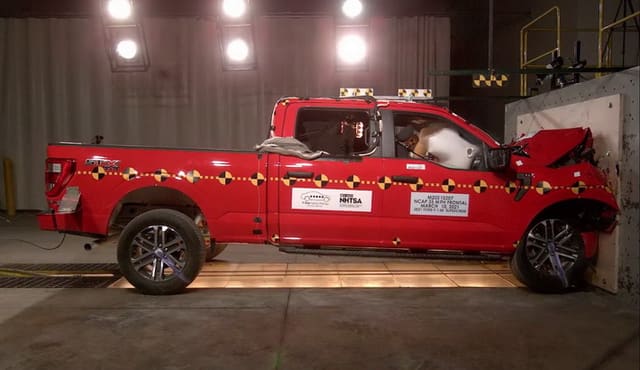
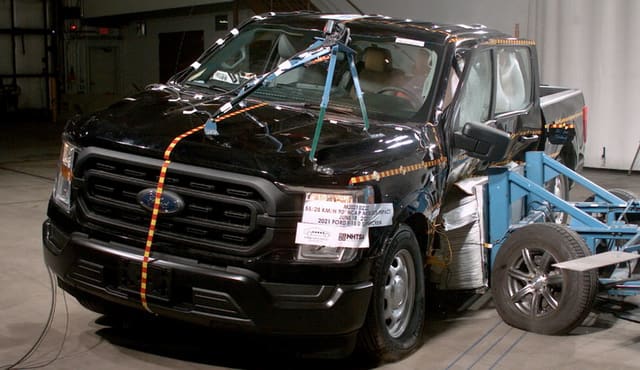
Crash-test photos: NHTSA (public domain). NHTSA can reuse a test for later model years of the same design.
Compared with other years
Complaints per year on sale divide each model year's NHTSA complaints by the years since it went on sale, so older and newer Ford F-150s can be compared fairly. Among other 2021 models in the EPA's standard pickup trucks class, the 2021 Ram 1500 (26 mpg) and 2021 Chevy Silverado 1500 (27 mpg) come closest on combined fuel economy.
| Year | Best mpg | Complaints | Per year on sale | Recalls |
|---|---|---|---|---|
| 2018 | 25 | 2,325 | 256 | 19 |
| 2019 | 25 | 1,341 | 166 | 9 |
| 2020 | 24 | 739 | 105 | 11 |
| 2021 | 25 | 1,299 | 214 | 29 |
| 2022 | 25 | 814 | 161 | 23 |
| 2023 | 25 | 510 | 125 | 13 |
| 2024 | 23 | 231 | 75 | 11 |
Every Ford F-150 model year compared →
Similar 2021 models
FAQ
Is the 2021 F-150 a good car?
We don't rate cars, but the official data gives a picture. The 2021 Ford F-150 has 214 NHTSA complaints per year on sale (2nd most of 17 model years), 29 recall campaigns, a best overall crash rating of 5 stars and up to 25 mpg combined from the EPA.
What are common 2021 F-150 problems?
The components owners report most to NHTSA are power train (447), electrical system (178) and exterior lighting (120). Complaints are unverified owner reports.
How many recalls does the 2021 F-150 have?
NHTSA lists 29 recall campaigns. To see whether a recall is still open on a specific car, enter its VIN at nhtsa.gov/recalls.
What gas mileage does the 2021 F-150 get?
The EPA rates the gasoline versions at 15–23 mpg combined (14–20 city, 16–27 highway). The hybrid versions reach up to 25 mpg combined.
How much does it cost to fuel a 2021 F-150 per year?
About $2,970 a year for 15,000 miles in its most efficient form, up to about $4,360 for the thirstiest version, using EPA mpg and the September 2026 U.S. average regular gasoline price of $4.36 a gallon (EIA).