2018 Ford F-150 MPG
EPA ratings for the 2018 Ford F-150 run from 15–22 mpg in town to 18–30 on the highway, or 16–25 combined, depending on which of its 38 versions you look at.
The most efficient pairs the 3.0-liter turbo 6-cylinder engine with an automatic transmission and rear-wheel drive, at 25 mpg combined. The thirstiest version uses the 3.5-liter turbo 6-cylinder engine with an automatic transmission and four-wheel drive and is rated 16 mpg combined. That is 3 mpg better than the best gasoline 2017 version (22 mpg).


| Version | Engine | Transmission | Drive | City | Hwy | Comb. | Fuel |
|---|---|---|---|---|---|---|---|
| F150 Pickup 2WD | 3.0 L 6-cyl turbo | Automatic (S10) | Rear-Wheel Drive | 22 | 30 | 25 | Diesel · 412 g CO₂/mi |
| F150 2WD BASE PAYLOAD LT TIRE | 3.0 L 6-cyl turbo | Automatic (S10) | Rear-Wheel Drive | 22 | 28 | 24 | Diesel · 424 g CO₂/mi |
| F150 Pickup 4WD XL/XLT | 3.0 L 6-cyl turbo | Automatic (S10) | Part-time 4-Wheel Drive | 21 | 28 | 24 | Diesel · 424 g CO₂/mi |
| F150 Pickup 2WD | 2.7 L 6-cyl turbo | Automatic (S10) | Rear-Wheel Drive | 20 | 26 | 22 | Regular · 401 g CO₂/mi |
| F150 2WD BASE PAYLOAD LT TIRE | 2.7 L 6-cyl turbo | Automatic (S10) | Rear-Wheel Drive | 20 | 25 | 22 | Regular · 401 g CO₂/mi |
| F150 Pickup 2WD | 3.3 L 6-cyl | Automatic (S6) | Rear-Wheel Drive | 19 | 25 | 22 | Regular · 410 g CO₂/mi |
| F150 Pickup 2WD FFV | 3.3 L 6-cyl | Automatic (S6) | Rear-Wheel Drive | 20 | 25 | 22 | Gasoline or E85 · 407 g CO₂/mi |
| F150 Pickup 4WD | 3.0 L 6-cyl turbo | Automatic (S10) | Part-time 4-Wheel Drive | 20 | 25 | 22 | Diesel · 463 g CO₂/mi |
| F150 4WD BASE PAYLOAD LT TIRE | 3.0 L 6-cyl turbo | Automatic (S10) | Part-time 4-Wheel Drive | 20 | 25 | 22 | Diesel · 463 g CO₂/mi |
| F150 Pickup 2WD | 3.5 L 6-cyl turbo | Automatic (S10) | Rear-Wheel Drive | 18 | 25 | 21 | Regular · 426 g CO₂/mi |
| F150 2.7L 2WD GVWR>6649 LBS | 2.7 L 6-cyl turbo | Automatic (S10) | Rear-Wheel Drive | 19 | 25 | 21 | Regular · 420 g CO₂/mi |
| F150 2WD BASE PAYLOAD LT TIRE | 3.3 L 6-cyl | Automatic (S6) | Rear-Wheel Drive | 19 | 24 | 21 | Regular · 423 g CO₂/mi |
| F150 Pickup 4WD | 2.7 L 6-cyl turbo | Automatic (S10) | Part-time 4-Wheel Drive | 19 | 24 | 21 | Regular · 423 g CO₂/mi |
| F150 2.7L 4WD GVWR>6799 LBS | 2.7 L 6-cyl turbo | Automatic (S10) | Part-time 4-Wheel Drive | 19 | 24 | 21 | Regular · 423 g CO₂/mi |
| F150 2WD FFV BASE PAYLOAD LT TIRE | 3.3 L 6-cyl | Automatic (S6) | Rear-Wheel Drive | 19 | 24 | 21 | Gasoline or E85 · 423 g CO₂/mi |
| F150 4WD BASE PAYLOAD LT TIRE | 2.7 L 6-cyl turbo | Automatic (S10) | Part-time 4-Wheel Drive | 18 | 23 | 20 | Regular · 444 g CO₂/mi |
| F150 Pickup 4WD | 3.3 L 6-cyl | Automatic (S6) | Part-time 4-Wheel Drive | 18 | 23 | 20 | Regular · 442 g CO₂/mi |
| F150 Pickup 4WD FFV | 3.3 L 6-cyl | Automatic (S6) | Part-time 4-Wheel Drive | 18 | 23 | 20 | Gasoline or E85 · 437 g CO₂/mi |
| F150 2WD BASE PAYLOAD LT TIRE | 3.5 L 6-cyl turbo | Automatic (S10) | Rear-Wheel Drive | 17 | 22 | 19 | Regular · 466 g CO₂/mi |
| F150 3.5L 2WD GVWR>7599 LBS | 3.5 L 6-cyl turbo | Automatic (S10) | Rear-Wheel Drive | 17 | 21 | 19 | Regular · 466 g CO₂/mi |
| F150 Pickup 2WD | 5.0 L 8-cyl | Automatic (S10) | Rear-Wheel Drive | 17 | 23 | 19 | Regular · 463 g CO₂/mi |
| F150 Pickup 4WD | 3.5 L 6-cyl turbo | Automatic (S10) | Part-time 4-Wheel Drive | 17 | 23 | 19 | Regular · 470 g CO₂/mi |
| F150 4WD BASE PAYLOAD LT TIRE | 3.5 L 6-cyl turbo | Automatic (S10) | Part-time 4-Wheel Drive | 17 | 22 | 19 | Regular · 468 g CO₂/mi |
| F150 4WD BASE PAYLOAD LT TIRE | 3.3 L 6-cyl | Automatic (S6) | Part-time 4-Wheel Drive | 17 | 22 | 19 | Regular · 468 g CO₂/mi |
| F150 4WD FFV BASE PAYLOAD LT TIRE | 3.3 L 6-cyl | Automatic (S6) | Part-time 4-Wheel Drive | 17 | 22 | 19 | Gasoline or E85 · 467 g CO₂/mi |
| F150 Pickup 2WD FFV | 5.0 L 8-cyl | Automatic (S10) | Rear-Wheel Drive | 17 | 23 | 19 | Gasoline or E85 · 457 g CO₂/mi |
| F150 2WD BASE PAYLOAD LT TIRE | 5.0 L 8-cyl | Automatic (S10) | Rear-Wheel Drive | 16 | 21 | 18 | Regular · 493 g CO₂/mi |
| F150 3.5L 4WD GVWR>7599 LBS | 3.5 L 6-cyl turbo | Automatic (S10) | Part-time 4-Wheel Drive | 16 | 21 | 18 | Regular · 494 g CO₂/mi |
| F150 Pickup 4WD | 5.0 L 8-cyl | Automatic (S10) | Part-time 4-Wheel Drive | 16 | 22 | 18 | Regular · 485 g CO₂/mi |
| F150 2WD FFV BASE PAYLOAD LT | 5.0 L 8-cyl | Automatic (S10) | Rear-Wheel Drive | 16 | 21 | 18 | Gasoline or E85 · 491 g CO₂/mi |
| F150 Pickup 4WD FFV | 5.0 L 8-cyl | Automatic (S10) | Part-time 4-Wheel Drive | 16 | 22 | 18 | Gasoline or E85 · 498 g CO₂/mi |
| F150 5.0L 2WD GVWR>7599 LBS | 5.0 L 8-cyl | Automatic (S10) | Rear-Wheel Drive | 16 | 20 | 17 | Regular · 522 g CO₂/mi |
| F150 5.0L 4WD GVWR>7599 LBS | 5.0 L 8-cyl | Automatic (S10) | Part-time 4-Wheel Drive | 15 | 19 | 17 | Regular · 523 g CO₂/mi |
| F150 4WD BASE PAYLOAD LT TIRE | 5.0 L 8-cyl | Automatic (S10) | Part-time 4-Wheel Drive | 16 | 20 | 17 | Regular · 523 g CO₂/mi |
| F150 5.0L 2WD FFV GVWR>7599 LBS | 5.0 L 8-cyl | Automatic (S10) | Rear-Wheel Drive | 16 | 20 | 17 | Gasoline or E85 · 520 g CO₂/mi |
| F150 5.0L 4WD FFV GVWR>7599 LBS | 5.0 L 8-cyl | Automatic (S10) | Part-time 4-Wheel Drive | 15 | 19 | 17 | Gasoline or E85 · 523 g CO₂/mi |
| F150 4WD FFV BASE PAYLOAD LT | 5.0 L 8-cyl | Automatic (S10) | Part-time 4-Wheel Drive | 16 | 20 | 17 | Gasoline or E85 · 522 g CO₂/mi |
| F150 RAPTOR 4WD | 3.5 L 6-cyl turbo | Automatic (S10) | Part-time 4-Wheel Drive | 15 | 18 | 16 | Regular · 546 g CO₂/mi |
2018 Ford F-150 fuel cost per year
Driving 15,000 miles a year on regular gasoline at the September 2026 U.S. average of $4.36 a gallon, the 2018 Ford F-150 costs about $2,970 a year to fuel in its most efficient form (22 mpg combined), or roughly 20 cents a mile.
The thirstiest priced version (16 mpg combined) comes to about $4,080 a year, $1,110 more.
This is an estimate from EPA combined mpg and the EIA national average price; your cost depends on how and where you drive and on local prices.
2018 Ford F-150 specs
2018 Ford F-150 buyers could choose between 5 engines, according to EPA records: 5.0 L 8-cyl, 3.3 L 6-cyl, 3.5 L 6-cyl turbo, 2.7 L 6-cyl turbo and 3.0 L 6-cyl turbo. It came with an automatic transmission, in four-wheel drive or rear-wheel drive versions. The EPA classes it as a standard pickup truck.
| Engine size (L) | Cylinders | Transmissions | Drive | Versions |
|---|---|---|---|---|
| 5.0 L | 8 | Automatic (S10) | Rear-Wheel Drive; Part-time 4-Wheel Drive | 12 |
| 3.3 L | 6 | Automatic (S6) | Rear-Wheel Drive; Part-time 4-Wheel Drive | 8 |
| 3.5 L turbo | 6 | Automatic (S10) | Rear-Wheel Drive; Part-time 4-Wheel Drive | 7 |
| 2.7 L turbo | 6 | Automatic (S10) | Rear-Wheel Drive; Part-time 4-Wheel Drive | 6 |
| 3.0 L turbo | 6 | Automatic (S10) | Rear-Wheel Drive; Part-time 4-Wheel Drive | 5 |
2018 Ford F-150 problems
Owners have filed 2,325 complaints about the 2018 Ford F-150 with NHTSA, the U.S. vehicle-safety agency, as of October 2026.
Power train is the most-reported area (35% of component mentions), followed by engine (18%) and structure (7%).
Spread over its time on sale, that is 256 complaints a year: more than the 2017 (145 a year) and the 2019 (166 a year).
No other Ford F-150 model year from 2008 to 2024 has more complaints per year on sale.
Of the 2,325, 64 mention a crash, 33 a fire and 38 an injury.
| Component | Mentions | Share |
|---|---|---|
| Power train | 1,022 | 35% |
| Engine | 510 | 18% |
| Unknown or other | 235 | 8% |
| Structure | 193 | 7% |
| Electrical system | 173 | 6% |
| Engine and engine cooling | 88 | 3% |
| Steering | 83 | 3% |
| Vehicle speed control | 73 | 3% |
| Service brakes | 72 | 2% |
| Fuel/propulsion system | 57 | 2% |
| Latches/locks/linkages | 57 | 2% |
| Visibility/wiper | 54 | 2% |
| Wheels | 46 | 2% |
| Air bags | 38 | 1% |
| Visibility | 37 | 1% |
| Back over prevention | 30 | 1% |
| Exterior lighting | 23 | <1% |
| Suspension | 23 | <1% |
| Hydraulic service brakes | 20 | <1% |
| Seat belts | 16 | <1% |
| Seats | 14 | <1% |
| Forward collision avoidance | 10 | <1% |
| Gasoline fuel system | 6 | <1% |
| Electronic stability control (esc) | 5 | <1% |
| Equipment | 4 | <1% |
| Lane departure | 3 | <1% |
| Air service brakes | 2 | <1% |
| Tires | 2 | <1% |
| Diesel fuel system | 1 | <1% |
| Traction control system | 1 | <1% |
| Trailer hitches | 1 | <1% |
What owners told NHTSA
I had a recall on my replacement transmission. Recall stated it may be missing a part. I had all the problems listed. It was replace 4 years ago. The dealer said i don't qualify for the recall. …
Excessive oil consumption of approximately 1 qt every 1000 miles. I am filing the oil to the acceptable level monthly.
I am getting heavy water intrusion from the rear sliding glass window after any rain. It creates a very musty unpleasant odor in the cab. …
2018 Ford F-150 recalls
NHTSA lists 18 recall campaigns for the 2018 Ford F-150, plus 1 recall of replacement equipment made for it.
The most recent, campaign 26V375000 from June 2026, concerns power train.
Power train accounts for 4 of the 19 campaigns, more than any other area.
26V375000 · June 9, 2026 · Power train
Problem: Quickly moving the shift lever from Park to Drive may cause a loss of gear indication on the instrument cluster display and a momentary selection of an unintended gear, such as Reverse or Neutral.
Risk: Unintended gear selection may cause the vehicle to move in an unexpected direction, increasing the risk of crash or injury.
Remedy: Dealers will update the powertrain control module software, free of charge.
21V983000 · December 16, 2021 · Latches/locks/linkages
Problem: The tailgate latches may unlatch unexpectedly while driving.
Risk: Unexpected tailgate opening may allow unrestrained cargo to fall out of the truck bed and become a road hazard, increasing the risk of a crash.
Remedy: Dealers will replace the left-hand and right-hand tailgate latches, free of charge.
21V155000 · March 10, 2021 · Tires
Problem: On the affected vehicles, it is possible that one or more tires were cured for too long during tire production.
Risk: Over cured tires may develop a break in the sidewall, resulting in sudden air loss or belt edge separation which could lead to tread/belt loss.
Remedy: Ford will notify owners, and dealers will inspect the tires, and replace them as necessary, free of charge.
18V392000 · June 12, 2018 · Gasoline fuel system
Problem: These vehicles have high pressure fuel pump assemblies with welds that can fracture, which may cause an oil or fuel leak.
Risk: A fuel leak in the presence of an ignition source may increase the risk of a fire.
Remedy: Ford will notify owners, and dealers will replace the high pressure fuel pump and associated components, free of charge.
18V214000 · April 4, 2018 · Power train
Problem: The gear shift cable clip may not be properly seated, allowing the transmission to be in a different gear than indicated by the gear shift lever position.
Risk: If the gear shift cable clip becomes unseated or dislodged, the gear shift lever position may indicate that the transmission is in 'Park' when it may be in a different gear.
Remedy: Ford will notify owners, and dealers will inspect the shift cable locking clip and properly seat it, if necessary, free of charge.
17V672000 · October 23, 2017 · Engine
Problem: The cylinder heads may have been machined without lubrication supply holes for the camshaft bearing journals.
Risk: Without a proper supply of lubrication, the engine will fail, causing a stall and increasing the risk of a crash.
Remedy: Ford is not aware of any affected vehicles outside of dealer control.
17V669000 · October 23, 2017 · Power train
Problem: Quickly moving the shift lever from Park to Drive may cause a loss of gear indication on the instrument cluster display and a momentary selection of an unintended gear, such as Reverse or Neutral before the vehicle achieves Drive function.
Risk: Unidentified or unintended gear selection may cause the vehicle to move in a way that was not intended by the driver, increasing the risk of crash or injury.
Remedy: Ford will notify owners, and dealers will reprogram the powertrain control module, free of charge.
17V598000 · September 25, 2017 · Structure
Problem: The structural roof braces may be missing rivets at the attachment of the roof rail, thereby reducing the structural integrity.
Risk: If the structural integrity is reduced, in the event of a rollover crash, there may be an increased risk of injury .
Remedy: Ford will notify owners, and dealers will install the rivets for the roof brace attachments, free of charge.
| Campaign | Reported | Component | F-150 years covered |
|---|---|---|---|
| 26V373000 | June 9, 2026 | Exterior lighting | 2018–2020 |
| 25V236000 | April 11, 2025 | Hydraulic service brakes | 2017–2018 |
| 24V852000 | November 8, 2024 | Equipment | 2018–2024 |
| 22V150000 | March 11, 2022 | Hydraulic service brakes | 2016–2018 |
| 21E027000 | April 12, 2021 | Suspension (equipment) | 2015–2018 |
| 20V097000 | February 21, 2020 | Exterior lighting | 2018–2020 |
| 19V633000 | August 28, 2019 | Seats | 2018–2020 |
| 19V278000 | April 8, 2019 | Engine, Equipment | 2015–2019 |
| 18V894000 | December 18, 2018 | Engine | 2015–2019 |
| 18V568000 | August 31, 2018 | Seat belts, Structure | 2015–2018 |
| 18V213000 | April 4, 2018 | Power train | 2017–2018 |
Safety ratings
NHTSA crash-tested 6 versions of the 2018 Ford F-150; the best overall score is 5 out of 5 stars.
Its Regular Cab PU/RC 4x2, Regular Cab PU/RC 4x4, Supercab PU/EC 4x2 and Supercab PU/EC 4x4 versions scored 4 stars overall.
| Version tested | Overall | Frontal | Side | Rollover |
|---|---|---|---|---|
| Regular Cab PU/RC 4x2 | ★★★★☆ | ★★★★☆ | ★★★★★ | ★★★★☆ |
| Regular Cab PU/RC 4x4 | ★★★★☆ | ★★★★☆ | ★★★★★ | ★★★★☆ |
| Super Crew PU/CC 4x2 | ★★★★★ | ★★★★★ | ★★★★★ | ★★★★☆ |
| Super Crew PU/CC 4x4 | ★★★★★ | ★★★★★ | ★★★★★ | ★★★★☆ |
| Supercab PU/EC 4x2 | ★★★★☆ | ★★★★☆ | ★★★★★ | ★★★★☆ |
| Supercab PU/EC 4x4 | ★★★★☆ | ★★★★☆ | ★★★★★ | ★★★★☆ |
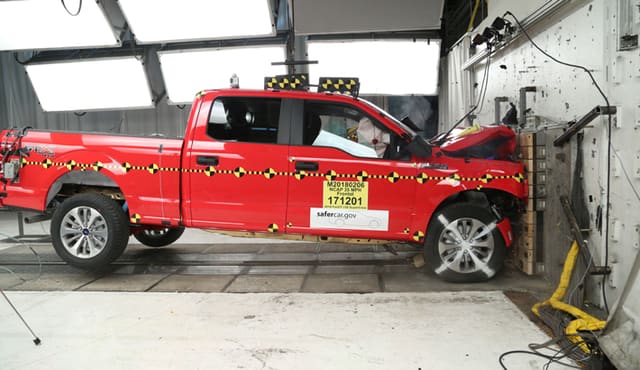
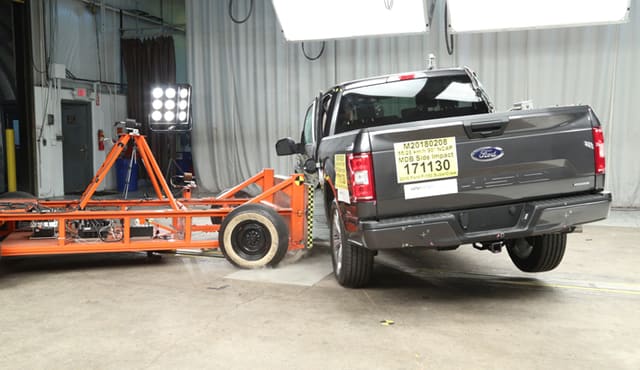
Crash-test photos: NHTSA (public domain). NHTSA can reuse a test for later model years of the same design.
Compared with other years
Complaints per year on sale divide each model year's NHTSA complaints by the years since it went on sale, so older and newer Ford F-150s can be compared fairly. Among other 2018 models in the EPA's standard pickup trucks class, the 2018 Ram 1500 (23 mpg) and 2018 Chevy Silverado 1500 (20 mpg) come closest on combined fuel economy.
| Year | Best mpg | Complaints | Per year on sale | Recalls |
|---|---|---|---|---|
| 2015 | 22 | 1,739 | 144 | 14 |
| 2016 | 21 | 2,084 | 188 | 14 |
| 2017 | 22 | 1,460 | 145 | 18 |
| 2018 | 25 | 2,325 | 256 | 19 |
| 2019 | 25 | 1,341 | 166 | 9 |
| 2020 | 24 | 739 | 105 | 11 |
| 2021 | 25 | 1,299 | 214 | 29 |
Every Ford F-150 model year compared →
Similar 2018 models
FAQ
Is the 2018 F-150 a good car?
We don't rate cars, but the official data gives a picture. The 2018 Ford F-150 has 256 NHTSA complaints per year on sale (the most of its 17 model years), 18 recall campaigns, a best overall crash rating of 5 stars and up to 25 mpg combined from the EPA.
What are common 2018 F-150 problems?
The components owners report most to NHTSA are power train (1,022), engine (510) and structure (193). Complaints are unverified owner reports.
How many recalls does the 2018 F-150 have?
NHTSA lists 18 recall campaigns and 1 replacement-equipment recall. To see whether a recall is still open on a specific car, enter its VIN at nhtsa.gov/recalls.
What gas mileage does the 2018 F-150 get?
The EPA rates the versions at 16–25 mpg combined (15–22 city, 18–30 highway).
How much does it cost to fuel a 2018 F-150 per year?
About $2,970 a year for 15,000 miles in its most efficient form, up to about $4,080 for the thirstiest version, using EPA mpg and the September 2026 U.S. average regular gasoline price of $4.36 a gallon (EIA).