2014 Nissan Rogue MPG
EPA ratings for the 2014 Nissan Rogue run from 22–25 mpg in town to 27–32 on the highway, or 24–28 combined, depending on which of its 4 versions you look at.
The most efficient pairs the 2.5-liter 4-cylinder engine with a CVT and front-wheel drive, at 28 mpg combined. At the other end, the 2.5-liter 4-cylinder engine with a CVT and all-wheel drive manages 24 mpg combined, 4 mpg less. That is 3 mpg better than the best gasoline 2013 version (25 mpg).


| Version | Engine | Transmission | Drive | City | Hwy | Comb. | Fuel |
|---|---|---|---|---|---|---|---|
| Rogue FWD | 2.5 L 4-cyl | Automatic (variable gear ratios) | Front-Wheel Drive | 25 | 32 | 28 | Regular · 317 g CO₂/mi |
| Rogue AWD | 2.5 L 4-cyl | Automatic (variable gear ratios) | All-Wheel Drive | 25 | 31 | 27 | Regular · 327 g CO₂/mi |
| Rogue Select FWD | 2.5 L 4-cyl | Automatic (variable gear ratios) | Front-Wheel Drive | 23 | 28 | 25 | Regular · 361 g CO₂/mi |
| Rogue Select AWD | 2.5 L 4-cyl | Automatic (variable gear ratios) | All-Wheel Drive | 22 | 27 | 24 | Regular · 372 g CO₂/mi |
2014 Nissan Rogue fuel cost per year
Driving 15,000 miles a year on regular gasoline at the September 2026 U.S. average of $4.36 a gallon, the 2014 Nissan Rogue costs about $2,330 a year to fuel in its most efficient form (28 mpg combined), or roughly 16 cents a mile.
The thirstiest priced version (24 mpg combined) comes to about $2,720 a year, $390 more.
This is an estimate from EPA combined mpg and the EIA national average price; your cost depends on how and where you drive and on local prices.
2014 Nissan Rogue specs
The EPA lists one engine for the 2014 Nissan Rogue: a 2.5 L 4-cyl. It came with a CVT, in all-wheel drive or front-wheel drive versions. For fuel-economy purposes it sits in the EPA's "Small Sport Utility Vehicle" class.
| Engine size (L) | Cylinders | Transmissions | Drive | Versions |
|---|---|---|---|---|
| 2.5 L | 4 | Automatic (variable gear ratios) | Front-Wheel Drive; All-Wheel Drive | 4 |
2014 Nissan Rogue problems
As of October 2026, NHTSA (the National Highway Traffic Safety Administration) holds 440 owner complaints about the 2014 Nissan Rogue.
Power train is the most-reported area (19% of component mentions), followed by air bags (12%) and electrical system (11%).
Spread over its time on sale, that is 34 complaints a year: fewer than the 2013 (43 a year) and the 2015 (46 a year).
That ranks 11th of 17 Nissan Rogue model years (2008–2024), counting from the most complaints per year.
Of the 440, 22 mention a crash, 9 a fire and 14 an injury.
| Component | Mentions | Share |
|---|---|---|
| Power train | 116 | 19% |
| Air bags | 74 | 12% |
| Electrical system | 68 | 11% |
| Unknown or other | 65 | 10% |
| Fuel/propulsion system | 64 | 10% |
| Engine | 53 | 9% |
| Vehicle speed control | 40 | 6% |
| Structure | 36 | 6% |
| Exterior lighting | 13 | 2% |
| Seats | 12 | 2% |
| Suspension | 11 | 2% |
| Visibility | 9 | 1% |
| Gasoline fuel system | 8 | 1% |
| Visibility/wiper | 8 | 1% |
| Electronic stability control (esc) | 7 | 1% |
| Seat belts | 7 | 1% |
| Service brakes | 7 | 1% |
| Steering | 7 | 1% |
| Wheels | 6 | <1% |
| Forward collision avoidance | 2 | <1% |
| Lane departure | 2 | <1% |
| Latches/locks/linkages | 2 | <1% |
| Tires | 2 | <1% |
| Engine and engine cooling | 1 | <1% |
| Firerelated | 1 | <1% |
What owners told NHTSA
While driving on the interstate and exiting at normal speed, my 2014 Nissan Rogue suddenly lost all propulsion. The engine continued to rev, but the transmission stopped delivering power to the wheels. …
While driving, I swerved slightly to avoid a dog and went into a shallow ditch less than one foot deep. There was no collision, no structural damage, and no repairs needed to the vehicle. …
1.I have water leaking into my driver side well which could start an electrical fire. 2. My hood came flying open while driving, there is a faulty hood latch.
2014 Nissan Rogue recalls
The 2014 Nissan Rogue has been the subject of 10 recall campaigns.
The most recent, campaign 23V093000 from February 2023, concerns electrical system.
Electrical system accounts for 3 of the 10 campaigns, more than any other area.
16V149000 · March 11, 2016 · Gasoline fuel system
Problem: Improper nickel plating of components within the fuel pump may result in the fuel pump failing.
Risk: If the fuel pump fails, the vehicle may stall without warning, increasing the risk of a crash.
Remedy: Nissan will notify owners, and dealers will replace the fuel pump, free of charge.
15V197000 · April 3, 2015 · Gasoline fuel system
Problem: Improper nickel plating of components within the fuel pump may result in the fuel pump failing.
Risk: If the fuel pump fails, the vehicle may stall without warning, increasing the risk of a crash.
Remedy: Nissan will notify owners, and dealers will replace the fuel pump, free of charge.
14V229000 · May 2, 2014 · Wheels
Problem: The right side wheels of the affected vehicles may have one lug nut each that was not properly tightened.
Risk: If the lug nut becomes loose from not being properly tightened, it may fall off, allowing the other lug nuts to become loose, possibly resulting in a wheel separation, and increasing the risk of a crash.
Remedy: Nissan will notify owners, and dealers will inspect and tighten any loose lug nuts to the correct specification, free of charge.
14V218000 · April 28, 2014 · Steering
Problem: In the affected vehicles, an incorrect bolt may have been used to connect the intermediate shaft to the upper steering assembly.
Risk: The incorrect bolts could loosen and fall out resulting in a loss of vehicle control and increasing the risk of a crash.
Remedy: Nissan will notify owners and, dealers will inspect and repair all affected vehicles, free of charge.
| Campaign | Reported | Component | Rogue years covered |
|---|---|---|---|
| 23V093000 | February 16, 2023 | Electrical system | 2014–2020 |
| 22V024000 | January 21, 2022 | Electrical system | 2014–2016 |
| 16V244000 | April 26, 2016 | Air bags | 2014–2017 |
| 16V219000 | April 15, 2016 | Structure | 2014–2016 |
| 15V032000 | January 26, 2015 | Electrical system | 2008–2014 |
| 15V012000 | January 14, 2015 | Service brakes | 2014–2015 |
Safety ratings
NHTSA crash-tested 2 versions of the 2014 Nissan Rogue; the best overall score is 4 out of 5 stars.
| Version tested | Overall | Frontal | Side | Rollover |
|---|---|---|---|---|
| SUV AWD | ★★★★☆ | ★★★☆☆ | ★★★★★ | ★★★★☆ |
| SUV FWD | ★★★★☆ | ★★★☆☆ | ★★★★★ | ★★★★☆ |
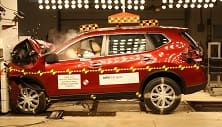
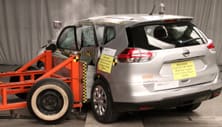
Crash-test photos: NHTSA (public domain). NHTSA can reuse a test for later model years of the same design.
Compared with other years
Complaints per year on sale divide each model year's NHTSA complaints by the years since it went on sale, so older and newer Nissan Rogues can be compared fairly. Among other 2014 models in the EPA's small sport utility vehicle class, the 2014 Mazda CX-5 (29 mpg), 2014 Subaru Forester (27 mpg) and 2014 Chevy Equinox (26 mpg) come closest on combined fuel economy.
| Year | Best mpg | Complaints | Per year on sale | Recalls |
|---|---|---|---|---|
| 2011 | 24 | 363 | 23 | 2 |
| 2012 | 25 | 319 | 21 | 2 |
| 2013 | 25 | 610 | 43 | 1 |
| 2014 | 28 | 440 | 34 | 10 |
| 2015 | 28 | 553 | 46 | 9 |
| 2016 | 28 | 543 | 49 | 7 |
| 2017 | 34 | 600 | 60 | 5 |
Every Nissan Rogue model year compared →
Similar 2014 models
FAQ
Is the 2014 Rogue a good car?
We don't rate cars, but the official data gives a picture. The 2014 Nissan Rogue has 34 NHTSA complaints per year on sale (11th most of 17 model years), 10 recall campaigns, a best overall crash rating of 4 stars and up to 28 mpg combined from the EPA.
What are common 2014 Rogue problems?
The components owners report most to NHTSA are power train (116), air bags (74) and electrical system (68). Complaints are unverified owner reports.
How many recalls does the 2014 Rogue have?
NHTSA lists 10 recall campaigns. To see whether a recall is still open on a specific car, enter its VIN at nhtsa.gov/recalls.
What gas mileage does the 2014 Rogue get?
The EPA rates the versions at 24–28 mpg combined (22–25 city, 27–32 highway).
How much does it cost to fuel a 2014 Rogue per year?
About $2,330 a year for 15,000 miles in its most efficient form, up to about $2,720 for the thirstiest version, using EPA mpg and the September 2026 U.S. average regular gasoline price of $4.36 a gallon (EIA).